маршрут
An extra hour over the Caspian: why flights from Sheremetyevo to Antalya now take the long way round
Planes from Moscow's hubs are skirting half of Ukraine and a chunk of the Caucasus — and that detour hits both your connection and your wallet.
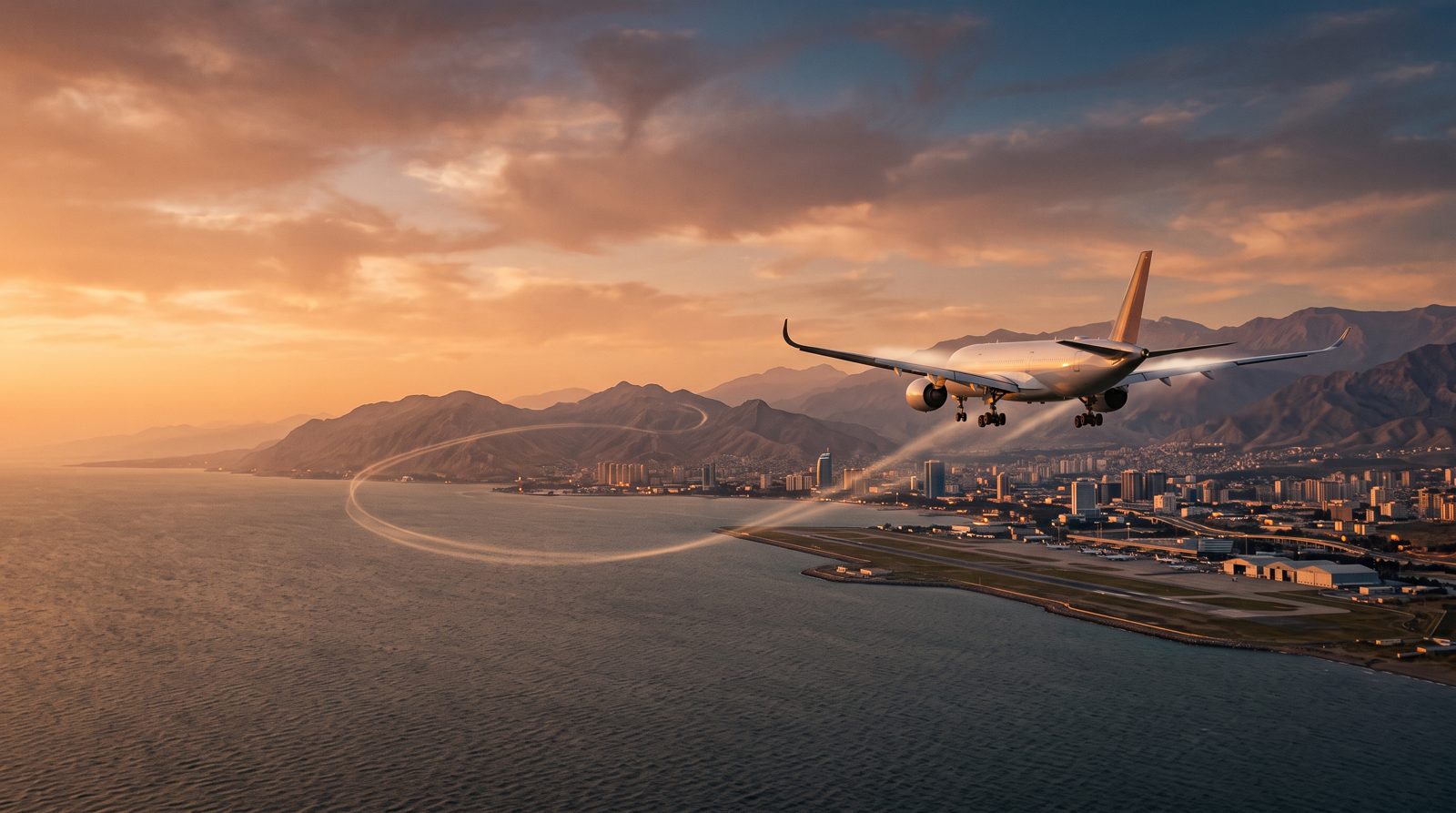
Open Flightradar24, pick any Aeroflot aircraft on the Sheremetyevo–Antalya route and look at the track. Not long ago, the line ran almost straight across Ukraine and the Black Sea. Now it bends in a wide arc to the east — past Volgograd, out over the Caspian, then a sharp turn west along the Turkish-Georgian border. It looks elegant on a map. It costs a fortune in practice.
The direct great-circle distance between these two airports is around 1,450 km. The actual flight path, with all the detours, runs past 1,900 km. That is 30–40% more distance, and you spend roughly an hour longer in the air than you would have on the same aircraft five years ago.
The reason is simple and dispiriting. Since February 2022, Ukrainian airspace has been completely closed — this is confirmed by the current NOTAMs. Added to that are sections over the Black Sea near the Russian coast, where airspace restrictions are published on a regular basis. There is simply no straight-line route available; aircraft have to swing east via the Caspian and enter Turkey from its eastern edge.
Why this is about more than just time
An extra hour in the air is not a minor inconvenience — it means fuel. A narrow-body Boeing 737 or Airbus A320 burns roughly 2.4–2.6 tonnes of fuel per hour at cruise. An additional 60 minutes works out to two and a half tonnes of fuel on every flight, each way. Airlines do not absorb that difference out of the goodness of their hearts — it is built into the fare. That is precisely why tickets from Moscow to Turkish resorts are holding higher than pure competition would suggest: the route has got longer, and the economics of the flight reflect that honestly.
There is a second dimension that Belarusians feel more sharply than Muscovites do. Many travellers fly to long-haul destinations via Russian hubs — Sheremetyevo, Vnukovo and Domodedovo remain convenient transfer points for Southeast Asia, Egypt and the UAE. When the first leg to that hub stretches by an hour, a tight connection is suddenly at risk. What looks like a comfortable 1h 40m layover on the schedule can collapse into a panicked sprint through the terminal if the first segment departs with the kind of delay that congested skies routinely produce.
What a passenger from Minsk should do about it
First — do not take the "travel time" figure shown by an aggregator at face value. Check real-world tracks on Flightradar24 for the past week on your specific flight. If the aircraft is consistently flying the eastern arc, build an extra hour each way into your planning when it comes to transfers, hotel check-in and meetings.
Second — when connecting through Russia, allow a minimum of 2.5–3 hours between segments, especially if they are on separate bookings. If you miss a connection because of a detour, no one will compensate you for split tickets.
Third — honestly compare the alternatives. Vilnius and Warsaw fly to Antalya via different corridors, without the Caspian loop, and often come out ahead on pure airborne time — even if the drive to the airport itself takes longer. Sometimes an extra hour behind the wheel to a Polish hub is more than offset by an hour saved in the sky and a far more predictable connection.
The airspace over this region has been redrawn not for a season or a year. For as long as the NOTAMs over Ukraine remain in force, the arc over the Caspian is the new normal for everyone departing Moscow heading south. The plane will get there. Just factor in that extra hour before you travel — not when you are already standing at the transfer desk.
Sources
- Flightradar24 — Треки и история рейсов SVO–AYT
- EUROCONTROL — Данные о закрытом воздушном пространстве и NOTAM
- Federal Air Transport Agency (Росавиация) — Действующие ограничения полётов в воздушном пространстве РФ